Sergeant Ron Harding personified Canuangra. A decorated veteran of the Malaya Campaign, he was a big ugly man, ulgy in appearance, ugly in his manner, ugly in his words, ugly in every imaginable way. There were none of the military niceties about him; he hated parades and saluting and following idiotic orders as much as we all did. But he was tough, rockhard in word and deed, ready to fight any man in the unit with the sure knowledge that he would smash them to bits. So we believed, anyway, for as long as we knew him, no one ever dared take him up on his constant urging for us to have a go. Harding was a man who was there to brutalise hardened men, to intimidate men who feared nothing, to test the metal of iron men. And at Canungra, it was our metal that was being tested, and Harding was the hammer and anvil.
“Well, now, starting right with that strawberry business the real truth is that I was betrayed and thrown and double-crossed by my executive officer and his precious gentleman Mr. Keith who between them corrupted my wardroom so that I was one man against a whole ship without any support from my officers—Now, you take that strawberry business—why, if that wasn’t a case of outright conspiracy to protect a malefactor from justice—Maryk carefully leaves out the little fact that I had conclusively proven by a process of elimination that someone had a key to the icebox. He said it was the steward’s mates who ate the strawberries but if I wanted to take the trouble I could prove to this court geometrically that they couldn’t have. It’s the water business all over again, like when the crew was taking baths seven times a day and our evaps were on the fritz half the time and I was trying to inculcate the simplest principles of water conservation, but no, Mr. Maryk, the hero of the crew wanted to go right on mollycoddling them and—or you take the coffee business—no, well, the strawberry thing first...”
“... it all hinged on a thorough search for the key and that was where Mister Maryk as usual with the help of Mister Keith fudged it. Just went through a lot of phoney motions that proved nothing and—Like thinking the incessant burning out of Silexes which were government property was a joke, which was the attitude of everybody from Maryk down, no sense of responsibility though I emphasized over and over that the war wouldn’t last forever, that all these things would have to be accounted for. It was a constant battle, always the same thing, Maryk and Keith undermining my authority, always arguments, although I personally like Keith and kept trying to train him up only to get stabbed in the back when—Kay, I think I’ve covered the strawberry business and—Oh yes, this mess account business...”
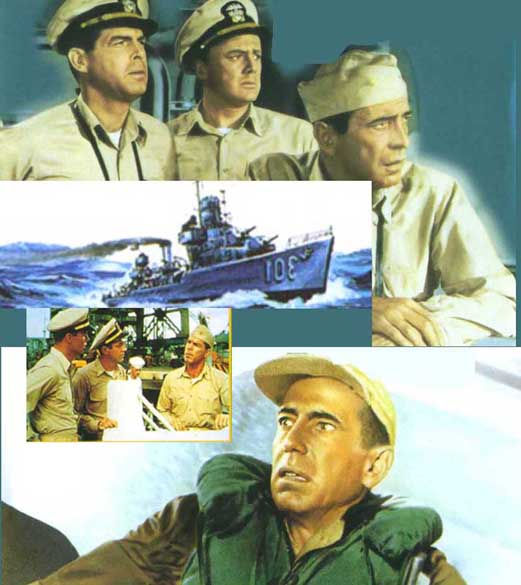
For anyone who didn’t recognise it, that’s Humphrey Bogart in the movie version of Herman Wouk’s great book The Caine Mutiny as Captain Queeg, metal balls rattling in his hand, condemning himself out of his own mouth while thinking he is doing the reverse. The continuation is from the play, The Caine Mutiny Court Martial, also by Wouk, which you may be interested to know, was the first piece of dramatic material ever done on Australian television. It was in fact a current stage performance filmed, and most of the actors had trouble maintaining their American accents.
But back to Bogart, in his last great role, who specialised in these long climatic speeches—the eight (or so) reasons why he will not allow Mary Astor to get away with murder in The Maltese Falcon, or the ‘don’t amount to a hill of beans’ valediction to Ingrid Bergman in Casablanca. But in fact in the original hit play, Lloyd Nolan played Queeg and Henry Fonda the defence attorney.
Now, once in the army, I soon realised that everyone had missed the point of this. What it was meant to convey was that in his childishness and paranoia, Queeg had failed as an officer. In fact, he was only being typical. All officers are just exactly as infantile and neurotic as he is portrayed at the court martial, and the real point is that if officers were all obliged to reveal and explain their behaviour before the general public and were as honest as Queeg about it, they would all be equally condemned. It is really the schoolyard tyranny of the military that is condemned here, and Queeg only incidentally for the crime of revealing the truth.
But you soon learn to humour them—these poor silly men deficient in every life-skill, and I should repeat here my philosophy on the matter from Running Dogs—”all officers are fifty percent less important than they seem and ninety percent less important than they think they are. They are ninety percent bullshit, but you have to humour them because the remaining ten percent is the bit where their stupidity is likely to get you killed. So you take the ten percent seriously and pretend to take the ninety percent seriously as well. But make sure you can tell the difference...”
Queeg’s court martial occurs because his perfectly normal officer behaviour is exposed in drama to the general public where the pretence cannot be allowed.