Now, I was never a great basketball player. I was a little taller than average, but I could successfully outreach much taller guys because I was bulky and could displace them. I was slow, never a really skilled ballhandler, but I did have an uncanny knack of getting difficult (and occasionally impossible) passes to find their target. And I was a thinker—I made up for my lack of talent by means of innovative moves. But none of these assets were the reasons why the girls’ insisted that I should be their coach. Protests from Donny and other envious lads concerning my numerous shortcomings as a player were of no interest to them either. There was only one reason; but it was the only thing that mattered to them.
“We feel safe with him,” they explained.
It was, when you think about it, the most tremendous insult imaginable.
“Now!” he said aloud and struck hard with both hands, gained a yard of line and then struck again and again, swinging with each arm alternately on the cord with all the strength of his arms and the pivoted weight of his body.
Nothing happened. The fish moved away slowly and the old man could not raise him an inch. His line was strong and made for heavy fish and he held it against his back until it was so taunt that beads of water were jumping from it. Then it began to make a slow hissing sound in the water and he still held it, bracing himself against the thwart and leaning back against the pull. The boat began to move slowly off toward the north-west.
The fish moved steadily and they travelled slowly on the calm water. The other baits were still on the water but there was nothing to be done.
“I wish I had the boy,” the old man said aloud. “I’m being towed by a fish and I’m towing bait. I could make the line fast. But then he could break it. I must hold him all I can and give him line when he must have it. Thank God he is travelling and not going down. What I will do if he decides to go down, I don’t know. What I’ll do if he sounds and dies I don’t know. But I’ll do something. There are plenty of things I can do."
He held the line against his back and watched its slant in the water and the skiff moving steadily to the north-west.
This will kill him, the old man thought. He can’t do this forever. But four hours later the fish was still swimming steadily out to sea, towing the skiff, and the old man was braced solidly with the line across his back..
“It was noon when I hooked him,” he said. “And I have never seen him.”
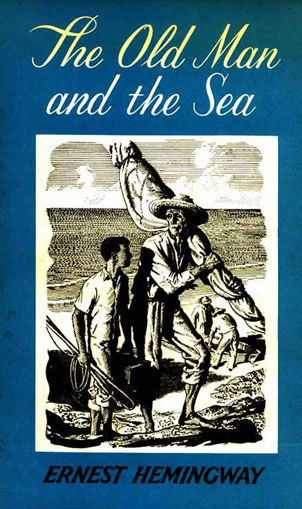
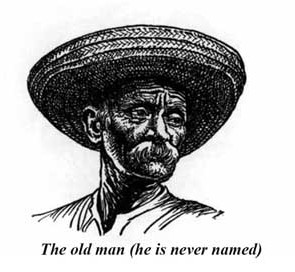
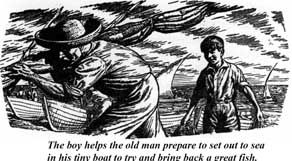
Ernest Hemingway wrote a number of fine books but undoubtedly his best was the novella The Old Man and the Sea. The old man is a Grand Banks fisherman and he sets out to prove he isn’t too old for the work. After a long search, he gets a huge Marlin on the line, but the fish tows the old man and his boat far out to sea, pausing from time to time to try and break free, then rushing on again. The old man is exhausted but he can't sleep in his tiny boat as it rushes onward because he must maintain the correct tension on the line. What is more important is that the fish is tiring to, and finally slows. The battle is won.
The fish puts up one last desperate fight, and then dies. The old man lashes it to the side of the boat and heads for shore. But all the way back, he has to fight the sharks that tear great strips from his trophy. By the time he gets back, there is little more than the head and skeleton left but that doesn’t matter. Sharks must live too, and the old man has what he wanted—proof that he caught the great fish.