As unimposing as they might have seemed, still they had drawn considerable public interest. It might have been a compliment that they were outnumbered by the constabulary gathered from Police Headquarters across the road, and the media cameramen had little else to do but study the faces of these women, as, you might have imagined, any ASIO agents in the crowd would surely have done. The media was there in full force, all papers, radio and television crews and therefore a substantial audience of passers-by who now cluttered the footpath and roadway to such an extent that more police were called in to control the traffic flow. Still more police moved amongst the onlookers, sometimes stopping to take names and addresses but more commonly trying to get them to move on—nothing could have been more futile—it was plain this incident was going to turn into a circus and no one was about to miss it. Except me, who realised that I very definitely did not want to be there.
“Bucky, what are we doing here?”
Bucky Buckland grinned at me proudly:
“See that lady at the top of the steps in the tartan suit and gold horn-rims. That’s me mum.”
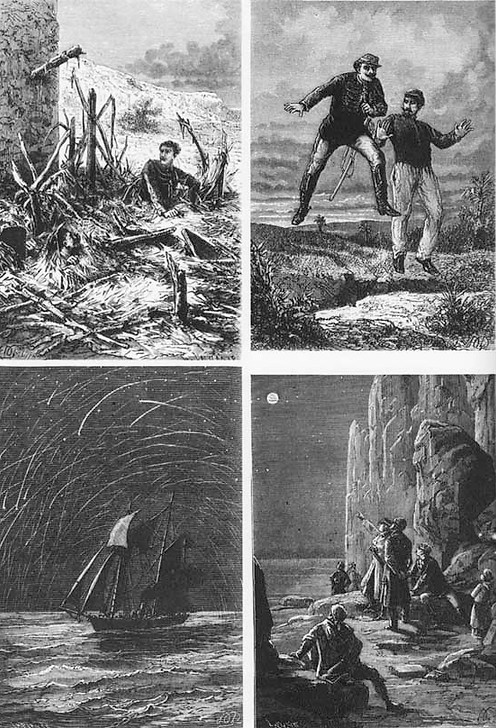
Most outrageous of all Jules Verne adventures is Hector Servadac which was published under several other titles, namely Anomolous Phenomenon & Homeward Bound being parts one and two, and in America Off on a Comet which gives the game away. For it is way over 200 pages in before Hector and his band of castaways figure out what has happened to them, and much of the fun lies in the observation of the extraordinary effects of the experience beforehand. But yes, a chunk of Earth (around Algeria) bearing our heroes is sucked up by a passing comet and carried off for a two year tour of the solar system. Verne somehow managed to keep this preposterous idea convincing at all times and his visualisation of the circumstances is brilliant. But you have to ignore how the air and sea remain unaffected by the transfer, not to mention the geography and the people. And when the comet returns and passes by the Earth again, they make their escape back home in a hot air balloon, through a vacuum, with neither breathing apparatus nor protection from the cold and the cosmic rays. But we know a lot more about outer space and comets than Verne did then. Nevertheless, a beauty.